Modified vs Unmodified Thinset Mortar: When and Where to Use Each
Comprehensive technical guide comparing ANSI A118.1 unmodified and ANSI A118.4 / A118.15 modified thinset mortars. Substrate compatibility, uncoupling membrane rules, shear bond physics, and fatal mistakes.
Modified vs Unmodified Thinset Mortar: When and Where to Use Each
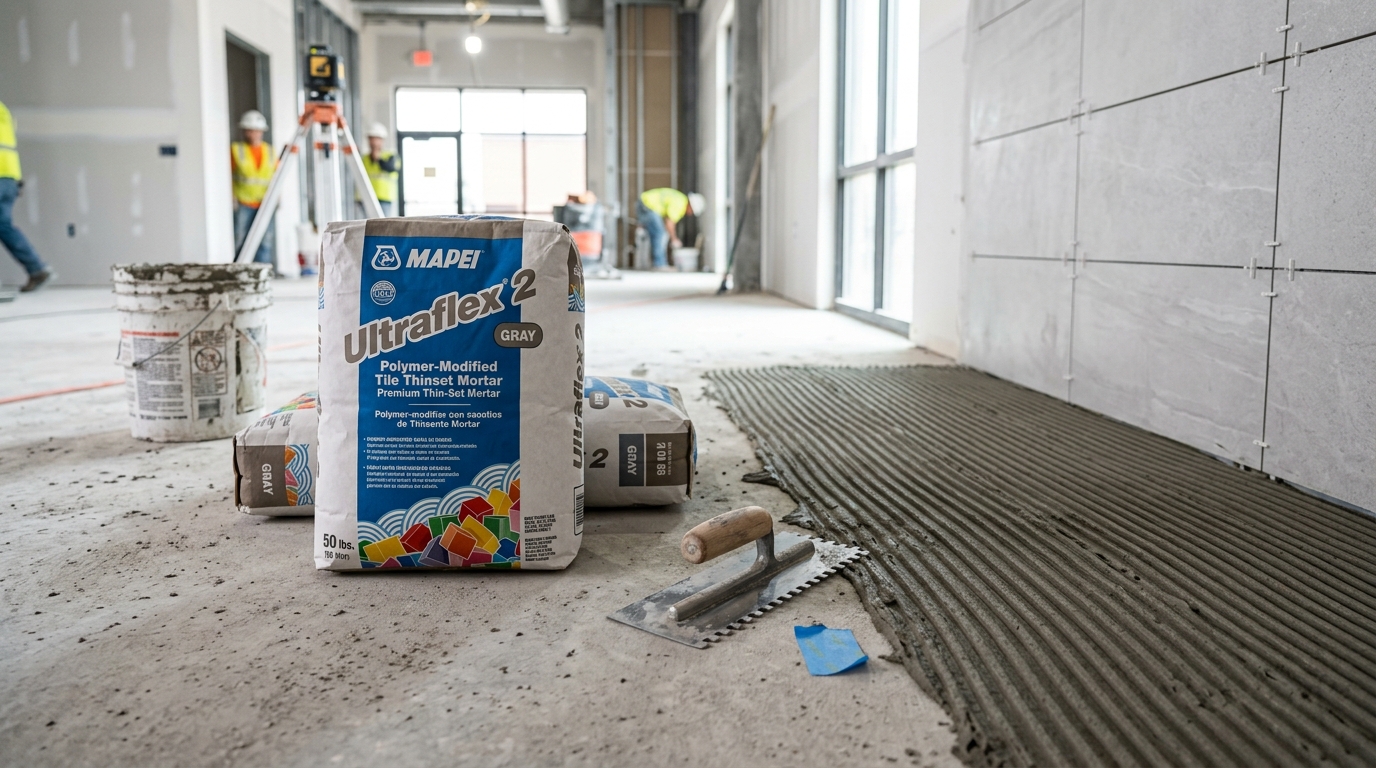
Choosing between modified and unmodified thinset mortar is the single most critical material specification decision in any tile installation. Selecting the incorrect chemistry over an uncoupling membrane, impervious waterproofing sheet, or flexing plywood subfloor is the leading cause of debonded, hollow, and cracked tile assemblies across North America.
While both products share Portland cement and graded silica aggregates, their curing mechanisms, internal shear strengths, and substrate moisture dependencies are fundamentally distinct.
Quick Reference Decision Matrix
| Substrate & Tile Assembly | Recommended Mortar Classification | Primary Chemical Requirement | Key Standard |
|---|---|---|---|
| Porcelain Tile over Concrete | Modified Thinset | Polymer adhesion to < 0.5% absorption body | ANSI A118.4 / A118.15 |
| Standard Ceramic over Cured Concrete | Unmodified or Modified | Standard hydraulic cement bond | ANSI A118.1 or A118.4 |
| Plywood / OSB Subfloors (Interior) | EGP Polymer-Modified | Elastic shear bond over flexing wood | ANSI A118.11 |
| Schluter DITRA to Plywood (Fleece Side) | Modified Thinset | Mechanical keying into wood grain | ANSI A118.11 / A118.4 |
| Tile over Schluter DITRA (Top Cavities) | Schluter ALL-SET or Unmodified | Moisture-independent cure between non-porous faces | Specialized Modified or ANSI A118.1 |
| Tile over Liquid Waterproofing (RedGard) | Modified Thinset | Strong polymer-to-polymer bond | ANSI A118.4 / A118.15 |
| Large Format Tile (12×24+) on Walls | Medium-Bed Non-Sag (LFT) | High-thixotropic polymer matrix | ANSI A118.4HT / A118.15HT |
| Submerged Pools, Fountains & Spas | High-Performance Polymer | Extreme water-immersion shear strength | ANSI A118.15 |
Chemical Mechanics: Hydraulic Crystals vs. Polymer Latex Coalescence
To understand why mortar failure occurs, we must examine what happens at the microscopic level during curing.
                    ┌─────────────────────────────────────────┐
                    │    DRY PORTLAND CEMENT + AGGREGATES     │
                    └────────────────────┬────────────────────┘
                                         │  + WATER
                                         ▼
            ┌────────────────────────────┴────────────────────────────┐
            ▼                                                         ▼
┌───────────────────────┐                                 ┌───────────────────────┐
│   UNMODIFIED MORTAR   │                                 │    MODIFIED MORTAR    │
│     (ANSI A118.1)     │                                 │ (ANSI A118.4/A118.15) │
└───────────┬───────────┘                                 └───────────┬───────────┘
            │                                                         │
            ▼                                                         ▼
┌───────────────────────┐                                 ┌───────────────────────┐
│  Hydraulic Reaction:  │                                 │  Hydraulic Crystals   │
│ Ettringite & C-S-H    │                                 │          PLUS         │
│ Needles Interlock     │                                 │ Redispersible Latex   │
│                       │                                 │ Cross-Linking Film    │
└───────────┬───────────┘                                 └───────────┬───────────┘
            │                                                         │
            ▼                                                         ▼
┌───────────────────────┐                                 ┌───────────────────────┐
│ Cures 100% in Sealed  │                                 │ Requires Internal     │
│ Moisture Conditions   │                                 │ Moisture Dissipation  │
│ (Air Not Needed)      │                                 │ for Polymer Film Form │
└───────────────────────┘                                 └───────────────────────┘
1. Unmodified Thinset (ANSI A118.1 Dry-Set)
Unmodified thinset consists strictly of Portland cement, carefully graded silica sand, and cellulose-based water retention agents. It contains zero synthetic resins or liquid latex polymers.
- Curing Mechanism: It cures entirely through hydraulic cement hydration. Water chemically binds with calcium silicates to form interlocking crystalline needles of calcium silicate hydrate (C-S-H) and ettringite.
- Air Independence: Hydraulic hydration is an exothermic chemical reaction. It does not require evaporation or air circulation. In fact, keeping unmodified mortar wet improves its final compressive hardness.
- Limitation: The crystalline matrix is rigid and brittle. It relies purely on mechanical suction into porous microscopic crevices of the tile and substrate. When applied to glass-smooth, vitrified porcelain (which absorbs virtually no water), unmodified mortar cannot establish a lasting grip.
2. Modified Thinset (ANSI A118.4 & ANSI A118.15)
Modified thinset incorporates redispersible synthetic polymer powders (typically Vinyl Acetate Ethylene [VAE], acrylic copolymers, or styrene-butadiene rubber) directly into the dry bag, or introduces liquid latex additives during mixing.
- Dual-Action Bond: As the Portland cement hydrates, the polymer particles coalesce into a continuous, flexible rubber-like microscopic web that weaves throughout the cement matrix.
- Micro-Adhesion: The polymers create molecular adhesion, allowing the mortar to stick tenaciously to non-porous porcelain, glass, metal lath, and existing glazed surfaces.
- Flexural Elasticity: The polymer web absorbs dynamic building vibrations, joist deflection, and temperature-induced thermal expansion without fracturing.
- Moisture Sensitivity During Cure: Standard redispersible polymer chains require excess water to leave the matrix (either absorbed into porous substrates or dispersed outward) in order to fully coalesce into their permanent elastic film.

The ANSI Engineering Standards Matrix
The American National Standards Institute (ANSI) establishes strict performance thresholds for tile mortars. When selecting thinset, verify the packaging displays these specific certifications:
| Standard | Description | 28-Day Glazed Wall Tile Shear | 28-Day Porcelain Mosaic Shear | 28-Day Water Immersion Shear | Approximate Cost (50 lb) |
|---|---|---|---|---|---|
| ANSI A118.1 | Standard Dry-Set Mortar (Unmodified) | 250 psi | < 100 psi (Fails) | 150 psi | $12 – $16 |
| ANSI A118.4 | Modified Dry-Set Cement Mortar | 300 psi | 200 psi | 150 psi | $18 – $28 |
| ANSI A118.11 | Exterior Glue Plywood (EGP) Latex Mortar | 300 psi | 150 psi (on plywood) | N/A | $22 – $32 |
| ANSI A118.15 | Improved Modified Dry-Set Mortar | 450+ psi | 400+ psi | 250+ psi | $34 – $55 |
Contractor Rule of Thumb: For high-value installations—such as heated floors, large format porcelain slabs, exterior balconies, or commercial entries—always upgrade from ANSI A118.4 to ANSI A118.15. The additional $15–$25 per bag provides a 100% increase in shear bond safety factor.
The Great Uncoupling Membrane Dilemma: Schluter DITRA vs. The Industry
No topic generates more heated contractor debate than mortar selection over uncoupling membranes. Understanding the engineering history eliminates all confusion:
Why Schluter Historically Required Unmodified Mortar
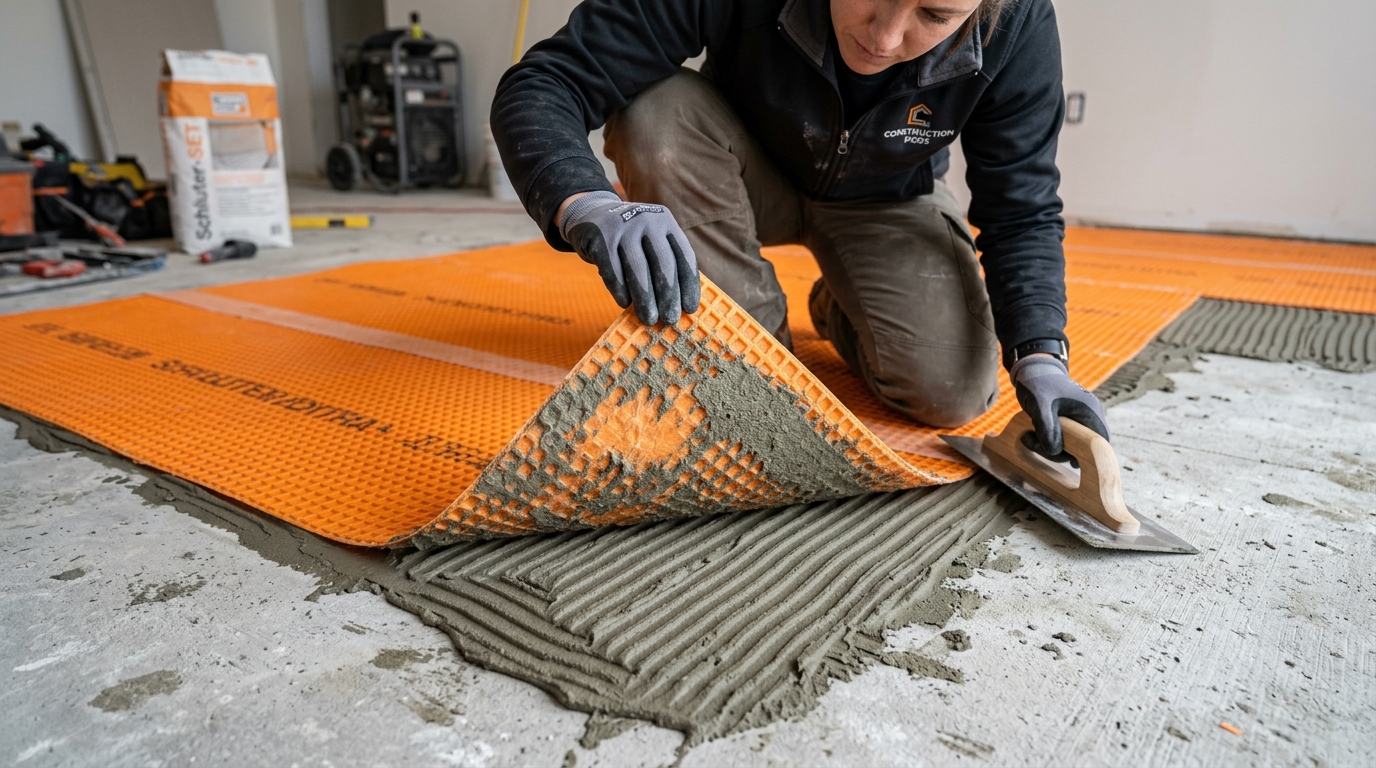
In the 1980s and 1990s, when Schluter introduced DITRA (an impermeable polypropylene sheet with dovetail cutback cavities and a fleece backing), standard modified mortars contained latex emulsions that required air evaporation to dry.
When an installer sandwiched standard modified mortar between an impervious plastic DITRA sheet on the bottom and a vitreous porcelain tile on top:
- Water had no evaporation route.
- The Portland cement hydrated, but the trapped latex polymers could not coalesce.
- The mortar remained a damp, putty-like slurry for weeks, allowing tiles to shift and grout joints to crack under foot traffic.
Consequently, Schluter mandated unmodified thinset (ANSI A118.1) for setting porcelain over DITRA, relying on the mechanical lock of the dovetail grid.
The Modern Solution: Specialized Hybrid Mortars
Today, the industry has evolved. Schluter introduced Schluter ALL-SET® and FAST-SET®, which are specialized polymer-modified mortars engineered with specialized cements and chemical water sinks that achieve complete curing even when sealed between impermeable plastic membranes and porcelain tiles.
Furthermore, competing uncoupling membranes (such as LATICRETE® STRATA_MAT™, Custom® RedGard® Mat, and ARDEX UI 720™) feature breathable capillary venting or open fleece architectures designed specifically for standard polymer-modified mortars (ANSI A118.4 and ANSI A118.15).
Substrate Compatibility Breakdown
1. Concrete Slabs
- On-Grade or Suspended Slabs: Both unmodified and modified mortars bond tenaciously to clean, porous concrete.
- Porcelain Tile over Concrete: Always use ANSI A118.4 or A118.15. Even though the concrete is porous, the porcelain tile back is non-absorbent.
- Porous Ceramic over Concrete: Unmodified ANSI A118.1 is fully acceptable and economical.
2. Plywood and OSB Subfloors
- The Rule: NEVER USE UNMODIFIED MORTAR DIRECTLY OVER WOOD.
- Wood expands, contracts, and flexes across structural joists with seasonal humidity swings. Portland cement alone possesses zero flexural strength; it will snap off plywood fibers within weeks.
- Specification: Direct bonding to plywood requires mortar meeting ANSI A118.11 (Exterior Glue Plywood), containing concentrated liquid acrylic or dry synthetic rubber polymers.
3. Cement Backer Units (Durock, HardieBacker, WonderBoard)
- The Rule: Always use Modified ANSI A118.4 or higher.
- Cement boards are intensely porous and draw water rapidly from fresh mortar. Modified mortars contain high-efficiency water-retention polymers (methylcellulose) that prevent the board from drying out the mortar before complete hydration occurs.
- Pro Tip: Always wipe cement backer board down with a damp sponge immediately prior to spreading thinset to break the surface dust barrier.
4. Liquid-Applied Waterproof Membranes (Custom RedGard, MAPEI Mapelastic AquaDefense, Laticrete Hydro Ban)
- The Rule: Modified Mortar is Mandatory.
- Once liquid rubber membranes cure into a continuous seamless sheet, they form an elastomeric, non-porous plastic barrier. Unmodified dry-set mortar will simply peel off cured rubber. Use an ANSI A118.4 or A118.15 mortar to ensure chemical adhesion to the elastomeric film.
5 Fatal Installation Blunders and Forensic Analysis
┌─────────────────────────────────────────────────────────────────────────┐
│                    TOP 5 THINSET FAILURE MECHANISMS                     │
├─────────────────────────────────────────────────────────────────────────┤
│ 1. Soft Putty Sandwich: Standard modified trapped under porcelain/sheet  │
│ 2. Pop-Off Porcelain: Unmodified mortar failing to grip vitreous body    │
│ 3. Wood Subfloor Shearing: Unmodified brittle mortar applied over OSB    │
│ 4. Large-Format Slumping: Standard thinset bedding 12×24 tiles on wall  │
│ 5. Winter Freeze-Thaw Spall: Unmodified water ingress cracking outdoors │
└─────────────────────────────────────────────────────────────────────────┘
Blunder 1: Using Standard Unmodified on Large Porcelain Slabs
- The Symptom: Months after installation, tiles begin making a hollow “clacking” sound when walked upon. Eventually, whole tiles pop cleanly off the mortar bed.
- Forensic Diagnosis: The back of the debonded tile shows pristine, unmarred porcelain with smooth indentations of the mortar ridges. Unmodified mortar lacks the microscopic polymer film required to grip vitrified porcelain (water absorption < 0.5%).
- Prevention: Always calculate and budget for ANSI A118.4 or A118.15 mortar when installing porcelain.
Blunder 2: Using Unmodified Mortar Over Wood Subfloors
- The Symptom: Grout lines disintegrate into powder along plywood sheet seams, followed by fractured tiles.
- Forensic Diagnosis: Lifting the broken tile reveals that the thinset has detached completely from the plywood subfloor, with splintered wood fibers stuck to dry cement chunks.
- Prevention: If bonding directly to an approved exterior glue plywood double layer, use only ANSI A118.11 certified mortar.
Blunder 3: Re-Tempering Stiffening Modified Mortar with Water
- The Symptom: Mortar begins to firm up in the mixing bucket after 45 minutes on a hot day. The helper pours 2 cups of water into the bucket and re-mixes with a drill. The installed floor later suffers from low compressive strength and crumbly mortar beds.
- Forensic Diagnosis: Adding water after the initial chemical hydration process has commenced breaks the forming crystalline lattice and dilutes the polymer concentration.
- Prevention: Once thinset begins to set in the bucket, discard it. Never re-temper mortar with additional water.
Step-by-Step Selection Flowchart
-
Identify the Tile Porosity:
- Vitrified Porcelain or Glass? → Must be Modified (ANSI A118.4 / A118.15).
- Porous Quarry or Ceramic? → Proceed to step 2.
-
Identify the Substrate:
- Wood / Plywood / OSB? → Must be ANSI A118.11 (or install an uncoupling membrane first).
- Liquid Waterproofing Membrane (RedGard)? → Must be Modified (ANSI A118.4 / A118.15).
- Cured Concrete Slab? → Proceed to step 3.
-
Identify the Tile Dimensions:
- Edge longer than 15 inches (e.g., 12×24, 24×48)? → Specify Medium-Bed Non-Sag (LFT / Large and Heavy Tile Mortar with HT designation).
Frequently Asked Questions
Can I use modified thinset over Schluter DITRA?
Yes, provided you use an approved formulation. Schluter officially approves their own modified mortars (Schluter ALL-SET® and FAST-SET®) over DITRA, as well as high-performance modified mortars from major manufacturers where specified. If using third-party mortars, consult the current Schluter DITRA Installation Handbook for active warranty conditions.
Can I make unmodified mortar “modified” by adding latex liquid?
Yes. Major manufacturers sell acrylic and latex mixing admixtures (such as MAPEI Planicrete AC, Custom Acrylic Mortar Admix, or Laticrete 333 Liquid). When mixed with an ANSI A118.1 powder in place of water, the assembly upgrades to meet ANSI A118.4 or ANSI A118.11 standards.
Does modified thinset take longer to dry than unmodified?
Yes. Under normal conditions (70°F / 21°C and 50% relative humidity), unmodified thinset achieves foot-traffic hardness in 12 to 24 hours. Modified thinset, particularly when placed beneath large impervious porcelain tiles, often requires 24 to 48 hours before grouting to allow polymers to stabilize.
Is modified thinset waterproof?
No cement-based mortar is fully waterproof on its own. While high-grade polymer-modified mortars (ANSI A118.15) dramatically resist water penetration and withstand continuous immersion in swimming pools, they do not replace an approved waterproofing membrane (such as Schluter KERDI, RedGard, or cementitious slurry coatings) in showers and wet areas.
What does the “HT” or “LFT” label mean on thinset bags?
“HT” stands for Heavy and Large Tile (formerly termed Medium-Bed mortar). These mortars are specially formulated with non-slump aggregate blends that support tiles heavier than 5 lbs per square foot without sinking into the mortar bed or extruding up through grout joints.
Why is unmodified thinset cheaper than modified?
Unmodified thinset contains only basic Portland cement, silica aggregate sand, and basic workability plasticizers ($12–$16 per bag). Modified mortars contain expensive powdered redispersible polymers, high-grade cross-linking resins, and anti-sag fibers, increasing raw material manufacturing costs to $25–$55 per bag.
Can I install mosaic glass tile with standard unmodified mortar?
No. Glass tile is completely non-porous and smooth. Standard unmodified mortar will not bond to glass. Furthermore, glass tiles can transmit the shadow of dark mortar through their body. Glass tiles require an ultra-white, high-polymer mortar meeting ANSI A118.15 or ANSI A118.16.
How do I know how many bags of mortar I need?
Mortar coverage depends directly on the trowel notch size required by your tile format and substrate flatness. Use our Thinset Coverage Calculator or Tile Project Calculator to compute exact bag counts, factoring in back-buttering and jobsite waste allowances.
Related Interactive Calculators
- DITRA Thinset Calculator – Calculate exact bag counts for fleece embedment and tile setting over Schluter membranes.
- Thinset Over Plywood Calculator – Compute ANSI A118.11 mortar requirements and verify joist deflection limits.
- 12×24 Thinset Calculator – Get exact medium-bed mortar yields and notch size recommendations for modern large-format tile.
- Thinset Water Ratio Calculator – Determine precise quart measurements for slaking and bucket mixing.
Ready to Calculate Thinset for Your Project?
Use our instant, trowel-aware calculator with manufacturer-specific coverage data.