Trowel Size Selection Guide for Every Tile Format: Notch Profiles, Coverage & Formulas
Master engineering guide to matching trowel notch sizes and profiles to tile formats. Square notch, U-notch, V-notch, and Euro-slant coverage formulas, collapsed bed calculations, and ANSI compliance.
Trowel Size Selection Guide for Every Tile Format: Notch Profiles, Coverage & Formulas
Selecting the appropriate trowel notch size is the single most critical factor in achieving the mandatory 80% (dry interior) or 95% (wet/exterior) continuous mortar contact required by ANSI A108.5.
Using a notch that is too small leaves hollow pockets beneath the tile, causing premature cracking under foot traffic. Conversely, choosing a notch that is excessively deep forces mortar to squeeze up through the grout joints, creating hours of tedious cleanup and weakening grout adhesion.
This guide provides the mathematical formulas, collapsed bed depths, coverage rates, and notch selection rules for every tile format—from micro-mosaics to gauged porcelain slabs.
Master Trowel Selection Matrix
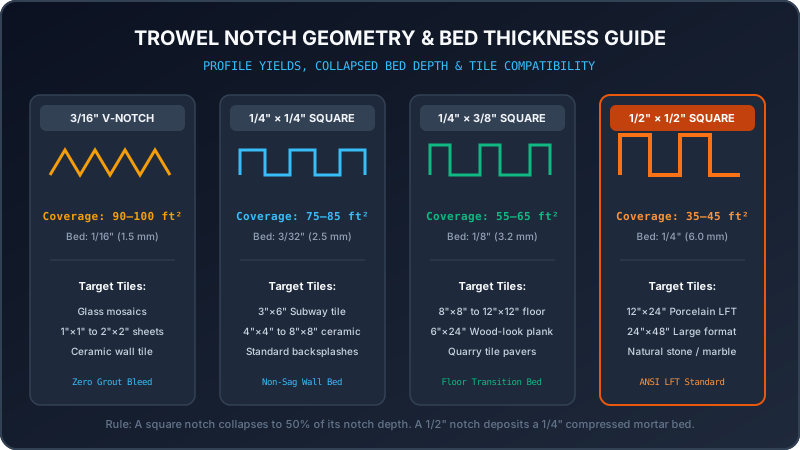
| Tile Dimensions & Format | Recommended Notch Size & Shape | Typical Bag Yield (50 lb) | Compressed Bed Thickness | Primary Trade Application |
|---|---|---|---|---|
| Glass / Ceramic Mosaics (≤ 2”×2”) | 3/16” × 5/32” V-Notch | 90 – 100 sq ft | ~1/16” (1.5 mm) | Prevents mortar bleeding through tiny grout lines |
| Subway Tile (3”×6”, 4”×8”) | 1/4” × 1/4” Square Notch | 75 – 85 sq ft | ~3/32” (2.5 mm) | Kitchen backsplashes & vertical shower walls |
| Medium Ceramic / Quarry (6” to 10”) | 1/4” × 3/8” Square Notch | 55 – 65 sq ft | ~1/8” (3.2 mm) | Residential floors with moderate substrate variation |
| Standard 12”×12” Ceramic / Stone | 1/4” × 3/8” Square or 3/8” U-Notch | 50 – 60 sq ft | ~1/8” to 5/32” | Traditional bathroom & utility floors |
| 12”×24” Large Format Tile (LFT) | 1/2” × 1/2” Square or Slant Notch | 35 – 45 sq ft | ~1/4” (6.0 mm) | Modern porcelain floors with mandatory back-butter |
| Plank Tiles (6”×36”, 8”×48”) | 1/2” × 1/2” Square Notch | 32 – 40 sq ft | ~1/4” (6.0 mm) | Accommodates natural plank crown & bowing |
| Gauged Porcelain Slabs (≥ 24”×48”) | Euro-Slant or 3/4” Half-Round | 28 – 35 sq ft | ~5/16” (8.0 mm) | Rapid ridge collapse under heavy mechanical suction |
The Mathematics of Trowel Ridges: How Much Mortar is Deposited?
A common misconception is that a 1/2” trowel leaves a 1/2” thick layer of mortar beneath the tile. In reality, a notched trowel deposits ridges that collapse to approximately 50% of their notch depth when combed at a 45-degree angle.
                  THE 50% RIDGE COLLAPSE MATHEMATICAL MODEL

        Troweled Ridges (At 45° Angle)            Compressed Mortar Bed
     ▲  ┌──┐      ┌──┐      ┌──┐
 1/2"│  │  │      │  │      │  │             ══════════════════════════ (Tile)
 (H) │  │  │      │  │      │  │       ──►   ▓▓▓▓▓▓▓▓▓▓▓▓▓▓▓▓▓▓▓▓▓▓▓▓▓▓ ~1/4" (H/2)
     ▼  └──┴──────┴──┴──────┴──┴──           ────────────────────────── (Subfloor)
1. Square Notch Geometry
For a square notch trowel where width equals depth:
Theoretical Compressed Bed Thickness = Notch Depth / 2- 1/4” × 1/4” Square Notch: Ridges collapse to approximately 3/32” to 1/8” (2.5 to 3.2 mm).
- 1/2” × 1/2” Square Notch: Ridges collapse to approximately 3/16” to 1/4” (5.0 to 6.4 mm).
2. The Trowel Angle Variable
The angle at which you hold the trowel relative to the substrate dramatically alters the volume of thinset deposited:
- Held at 45° (Standard): Yields standard manufacturer coverage and predictable ridge volume.
- Held at 30° (Too Flat): Drags mortar down, reducing ridge height by up to 35% and causing hollow tile voids.
- Held at 75° (Too Steep): Deposits taller ridges, reducing square foot coverage per bag and increasing squeeze-out.
Notch Profiles Compared: Square, U-Notch, V-Notch & Euro-Slant
1. Square Notch Trowel
- Characteristics: Flat-topped, vertical-sided ridges. Deposits the highest total volume of mortar per stroke.
- Pros: Maximum bed thickness for leveling irregular tiles and compensating for subfloor humps.
- Cons: Requires significant hand pressure to compress flat. Ridges can trap air if combed in circular swirls.
2. U-Notch Trowel
- Characteristics: Rounded, semicircular teeth. Ridges have a rounded crown.
- Pros: Ridges collapse significantly easier under less hand pressure than square notches. Air exhausts easily out the valleys.
- Cons: Slightly lower total mortar volume (~10% less) than a square notch of the same nominal dimensions.
3. V-Notch Trowel
- Characteristics: Triangular teeth that leave sharp, pointed pyramid ridges.
- Pros: Deposits a minimal, uniform skim coat (1/16”). Essential for mosaics where any excess mortar would bleed between tiny grout joints.
- Cons: Strictly limited to small, flat wall tiles. Completely unsuitable for floor installations or tiles larger than 4”×4”.
4. Euro-Slant / Collapsible Ridge Trowel
- Characteristics: Angled, parallelepiped teeth that deposit ridges pre-biased to tip over in one direction.
- Pros: Requires 40% less downward pressure to achieve complete ridge collapse. Superior air-release performance under large format tiles.
- Cons: Higher initial tool cost; requires consistent single-direction combing.
ANSI A108.5 Coverage Requirements: 80% vs. 95%
The American National Standards Institute (ANSI A108.5) establishes non-negotiable contact benchmarks:
┌─────────────────────────────────────────────────────────────────────────┐
│                     ANSI A108.5 COVERAGE MANDATES                       │
├─────────────────────────────────────────────────────────────────────────┤
│ • Dry Interior Living Areas: 80% Continuous Coverage                    │
│ • Wet Areas (Showers, Steam Rooms): 95% Continuous Coverage             │
│ • Exterior Balconies, Patios & Decks: 95% Continuous Coverage           │
│ • Commercial High-Traffic Corridors: 95% Continuous Coverage            │
│ • Corners & Edges: 100% Solid Support Within 2 Inches of Perimeter      │
└─────────────────────────────────────────────────────────────────────────┘
Why Wet Areas Demand 95% Coverage
In a shower pan or steam room, water continuously migrates through porous cement grout joints. If hollow pockets exist beneath the tile:
- Water pools in the dark voids beneath the tile.
- Stagnant moisture breeds black mold, mildew, and foul odors.
- In exterior freeze-thaw climates, pooled water expands by 9% upon freezing, generating thousands of pounds of hydraulic pressure that shears the tile right off the concrete slab.
5 Fatal Troweling Errors on the Jobsite
- Swirl Troweling (The “Rainbow” Arc): Combing mortar in circular motions creates closed chambers. When the tile is pressed down, air is trapped in the center of the arc, resulting in 40% to 60% hollow voids. Always comb in straight, parallel lines.
- Using a Worn-Down Trowel: Steel trowel teeth wear down over time against abrasive silica sand. A 1/2” trowel worn down to 3/8” deposits 25% less mortar, silently compromising your bond contact.
- Failing to “Burn” the Substrate: Always scrape a thin, flat coat of mortar into the substrate with the flat edge of your trowel before combing ridges. This keys the cement into the subfloor pores.
- Combing Along the Long Edge of Large Tiles: On 12×24 or 8×48 tiles, always comb parallel to the shortest edge. Trapped air must travel only 6 inches to exhaust, rather than 12 to 24 inches.
- Letting Ridges Skin Over: In hot or breezy conditions, thinset ridges develop a dry skin within 10 to 15 minutes. If you touch a ridge and mortar does not transfer cleanly to your fingertip, scrape it up and reapply fresh mortar.
Frequently Asked Questions
What trowel should I use for 3×6 subway tile?
For standard 3×6 ceramic subway wall tile, a 1/4” × 1/4” square notch trowel (or 1/4” × 3/16” V-notch) is ideal. It provides full coverage without forcing thinset out between the 1/16” grout joints.
How do I calculate how many bags of thinset I need?
Divide your total square footage (including a 10% cutting and waste margin) by the expected square foot yield of your specific trowel notch size. For example, a 200 sq ft room with a 1/2” trowel (yielding ~35 sq ft/bag) requires:
220 sq ft ÷ 35 = 6.3 bags → Purchase 7 bags. Use our Thinset Bag Calculator for instant calculations.
Can I use a 1/4” trowel for 12×24 floor tile?
No. A 1/4” trowel leaves a compressed bed of only ~3/32”, which cannot span the natural crown curvature of 24-inch tiles or accommodate subfloor undulations. You will fail to achieve the mandatory 80% coverage. Use a 1/2” × 1/2” square notch or Euro-slant trowel.
When is back-buttering required?
The TCNA recommends back-buttering for all tiles 12×12 or larger, all exterior installations, all natural stone, and anywhere 95% continuous contact is required (such as shower floors and wet areas).
Does a U-notch trowel use more thinset than a square notch?
No. A U-notch trowel uses roughly 10% less thinset than a square notch of the same nominal dimensions because the rounded valleys leave less volume than square 90-degree corners.
Related Interactive Calculators
- Thinset Trowel Size Calculator – Interactive notch selector based on tile dimensions and substrate conditions.
- 12×24 Thinset Calculator – Specific coverage, clip, and bag estimator for large format tiles.
- Mosaic Thinset Calculator – Specialized V-notch coverage calculator to prevent grout bleed on sheet-mounted tiles.
- Subway Tile Thinset Calculator – Wall thinset yields for vertical backsplash and shower surrounds.
Ready to Calculate Thinset for Your Project?
Use our instant, trowel-aware calculator with manufacturer-specific coverage data.